Showing posts with label Quentin Tarantino. Show all posts

Friday, January 25, 2013

DVD Review: "Safety" a Guaranteed Good Time

First things first. I don't review every movie I see--that'd be crazy, you guys--but I do make an effort to review the movies I feel are important to talk about. But when you rent a movie to watch with your friends over the weekend and end up watching it again the next day and then can't stop thinking about it for the proceeding couple of days, yeah, I think it's worth sharing.

Safety Not Guaranteed is that rare indie/comedy that I believe manages to please most people. It has an off-beat charm and equally charming off-beat characters that make us laugh and want to be in their circle of company. It surprises by having a genuine feel to it and a heart that I can't say I find in a lot of films these days. And did I mention the time-traveling thing? But at the center of the film, there's nothing science fiction about it.
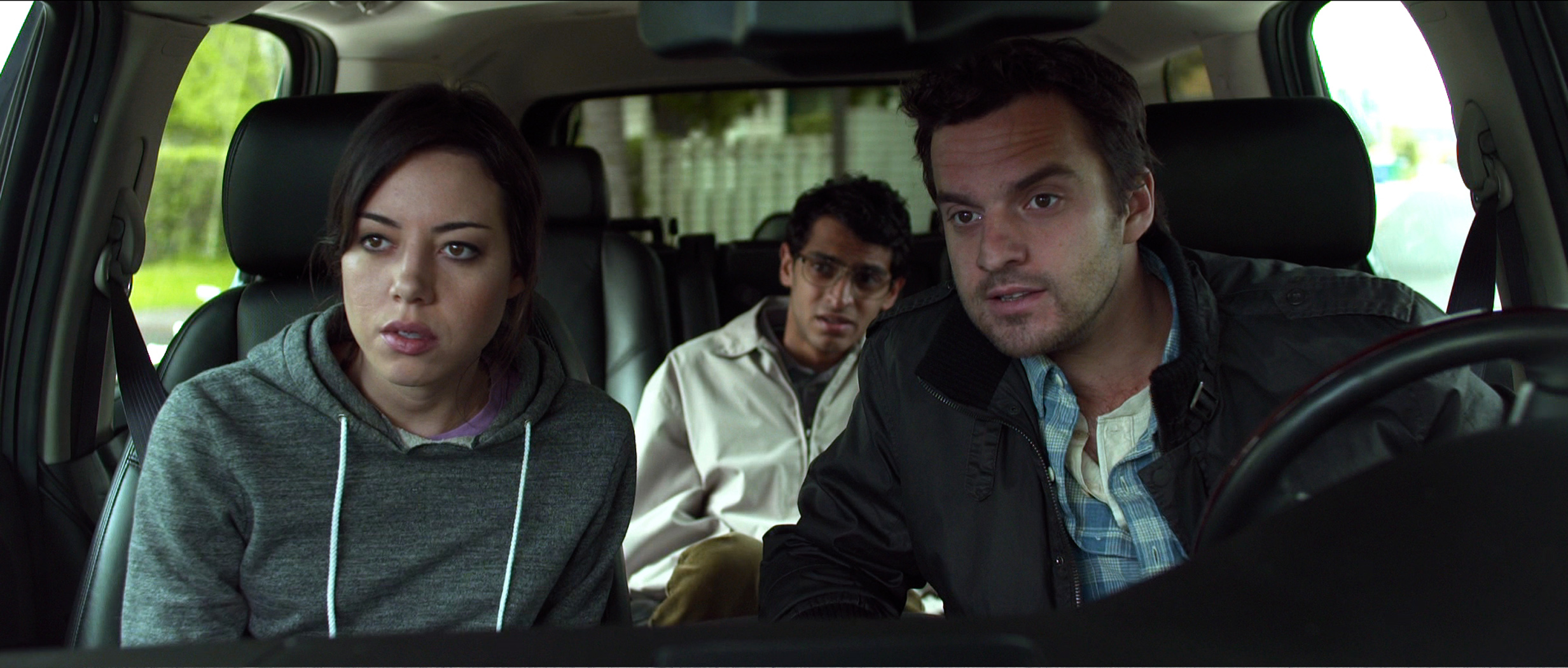
When a Seattle journalist (Jake Johnson) takes on a story about a man who puts up an ad seeking a time travel partner, he entails the help of two interns, "I'll take the Indian and the lesbian," he says, played by Aubrey Plaza (Parks and Rec) and Karan Soni. They drive out to an ocean side motel, expecting to find a schizophrenic-type mad man and instead find Kenneth (Mark Duplass), a seemingly normal guy, working at Bargain Outlet who believes he can time travel. Darius (Plaza) takes up Kenneth's offer and a few quirky verbal exchanges and strategic canned soup placement and Kenneth senses Darius worthy of partnership. However the deadline for the story quickly approaches and Darius is no closer to discovering what the man she's been spending so much time with is hiding.

The film works because it's well casted. Plaza and Duplass work amazing well together. He adds charm and yet harbors an austere, yet thoughtful side that gives his character so much dimension, you'd think he was playing a real person. And Plaza's trademark deadpan is only part of the fun in watching her. The rest relies on seeing her be unguarded for the first time. There's a scene, early on, where she's having dinner with her father (Jeff Garlin) and as funny as she is, you know there's a no-nonsense side we're going to see from her. My favorite character, however, was Johnson's Jeff, a womanizing magazine writer who drinks on the job and has more interest in reestablishing a connection with his high school sweet heart than getting the story. Jeff is crude, unprofessional, and unreliable, but his storyline is so crucial and his character is so likable you can't help but feel empathetic when he's upset. My most memorable scene from the film is when Jeff takes his shy intern to meet girls and they spend an evening at a fair. It sounds fun and comical, but Jeff's drunken stupor and childish behavior, all to the tune of Wye Oak's Civilian, make this scene more sobering and powerful than I expected it to.

But most sobering of all, was the realization that Guaranteed had little to nothing to do with time travel, although I'm sure the film will have people talking (think not so much Looper but more of Brit Marling's Another Earth and Sound of My Voice). The real time travel are the journeys these characters take forward with each other. Or in some cases, the time they spend still living in the past.

The film marks writer Derek Connolly's first feature film--and what a debut! I look forward to his future projects. Connolly re-teamed with director Colin Trevorrow; the two previously worked on the TV movie Gary: Under Crisis and Safety marks Trevorrow's first feature film, as well. Duplass also teamed up with frequent collaborator and brother Jay to executive produce the film. My only complaint was the decision to shoot this digitally, which made for some unpleasant exposure issues, but when you're working with a budget of less an $1 million, forgiveness comes easy.

Sometimes you spend an entire year looking forward to films from favorite directors like David O'Russell, Quentin Tarantino, Ben Affleck (hey, I didn't say favorite actor), Steven Spielberg, Tim Burton and Paul Thomas Anderson, you don't expect anything from a movie like this, which makes it all the more surprising and unforgettable when you do experience it (no weapons necessary, promise). I can't guarantee you'll love it, but I can guarantee I'll love it just as much the next time I watch it.

I also just wanted to thank Eric over at PMI (don't know him, just a big fan) for loving movies just as much as I do and for convincing me I couldn't wait any longer to see this film. Thanks Eric (even though you'll never read this.) And I want to thank anyone reading this for indulging me in what I love to do, even if you hate what I have to say. Thanks sooooooo much anyway.

Rating: A-

Tuesday, December 25, 2012

Django a certified Classic

*Edit:    
 Dear Readers, 

In the months since first watching this film, I have acquired a different viewing perspective shaped by time, my readings and brilliant professors that have caused me to have a change of heart. And I feel it is drastic enough for me to have to correct myself. I misinterpreted important themes displayed in the film and egregiously allowed myself to be a fan first, rather than a critic. 

Tarantino is an inspiring filmmaker, who I will forever hold a debt of gratitude for contributing to my love of cinema. However, I would be doing an injustice to myself and those of you who kindly read my reviews to grant any filmmaker immunity from an intelligent analysis of their work. For this reason, I must apologize. This review does not reflect my current opinion on Django Unchained or Tarantino. I hope you will forgive me, as I attempt to correct an ignorantly conceptualized review.

As I continue with my education and attempt to find my niche in film writing I hope to find a comfortable area that allows me to incorporate more theory in my reviews, because as more time goes by I feel myself gravitating towards theory rather than criticism. I'm currently planning a theoretical essay on racial stereotypes in American cinema that I hope will address my concerns and regression with Django Unchained that I will post here on this blog. I will keep you updated. 

For those of you who read my reviews, thank you for indulging me. It's both a pleasure and a privilege to be able to find a platform that allows me to write about something I'm passionate about.

P.S. An extra apology to Spike Lee (in case you're reading).

Sincerely Sorry,
Cristina Lule
The 2:50 showing was packed with theater goers wrapped in holiday scarves that were surely under the tree earlier that morning; even though we arrived there 20 minutes early, my family and I almost didn't get seats together; I had failed to notice the nearly three hour running time and didn't eat before leaving the house; and the guy next to me wreaked of cigarettes, but I didn't care. I was happily waiting for director/writer Quentin Tarantino's pre-Civil War revenge/drama to start. And let me say, he did not disappoint.

Set in the antebellum South, Django Unchained follows Dr. King Schultz (Christoph Waltz), a bounty hunter, disguised as a traveling dentist, searching for three brothers who only our protagonist and titular character (Jamie Foxx) can identify. In acquiring Django's help, Schultz sets him free and offers him a third of the reward for helping kill the men Schultz is looking for. We learn Django takes great pleasure in getting paid to kill white folks, as he puts it, but also discover he yearns to find his wife Broomhilda (Kerry Washington) and rescue her. What ensues is perhaps the most controversial and violent love story I have ever rooted for.

Tarantino is no stranger to controversy or even racial themes for that matter, i.e.: 1994's Pulp Fiction. But as uncomfortable as a subject this may be, he allows his audience to laugh, balancing brutality with some comical moments. In one scene, we see a group of KKK members struggling to see through their white hoods. Then, he quickly plunges us back into the seriousness of this era, particularly with flashbacks involving Broomhilda. How does he manage this? By rewriting history and turning ex-slave Django into a sort-of superhero, of course. Think Captain America with *eh-hem* some obvious differences on the ideals of freedom. Violent scenes are shot with a comic-book style. The blood that squirts out of Django's targets are so grotesquely glamorous, we awe more than cringe. We want to see it.

Tarantino is also no stranger to rewriting history. He killed Hitler after all, in 2009's Inglourious Basterds. There are some parallels to be drawn here: in Basterds, the Jews were the heroes, conspiring against German Nazi's, and here we watch a freed slave acquire a blood lust for slave owners. However, he's also playing off his theme of redemption with his actors. Here we have Waltz playing a slavery hating, German bounty hunter, where in Basterd's, the film that won him an Oscar, he played Col. Landa, a merciless "Jew Hunter." See how Tarantino reverses roles? Just take a look at his name: Dr. King Schultz. Or consider (my favorite character) Calvin Candie (Leonardo DiCaprio) an aristocratic plantation owner with a deplorable hobby in making his slaves fight to the death. With DiCaprio, we're so used to seeing him as the leading man/hero it's almost scary how much fun he appears to be having encouraging his fighter to kill his opponent.

Tarantino also marks this film with his trademark style. It's hard to make pop-culture references in the 1800's before pop-culture existed, so we get some nice historical references to the like of Hercules, Alexandre Dumas and German folklore. This also allows freedom in the music department, featuring a soundtrack with classical pieces like "Fur Elise" and a track from Rick Ross. There's also a beautiful Alexander Nevsky homage, specifically the "Battle on the Ice" sequence when we see the Klan members riding over a hill. We're also indulged in Tarantino's fascination with spaghetti Westerns and his employment of his trademark quick zoom on our gun-slinging hero is not lost on us. Waltz's character is perhaps the most enjoyable to watch, well versed and with a colorful vernacular, Tarantino puts his witty dialogue to good use with his character.

It's difficult to ignore the elephant in the room, so I'll just address it. It's easy to see how some audience members would accuse this film of negatively exploiting African American stereotypes. At times, the film did teeter-totter on the line of what is acceptable and what is socially deconstructive, but if we look at Tarantino's history, there is nothing to suggest the latter. For example, Tarantino's character in Fiction (and yes, expect him to make a cameo here again) goes on a rant filled with racial slurs when he finds out there's a dead black man in his garage and wants him gone before his wife comes home. Unbeknownst to us, at the time, his wife is, in fact, black. Is this racist? Probably, but we have to look at his intentions. In Django's depiction of slavery, did he go too far? I don't try to assume I know what goes on in the mind of a genius, but with a filmmaker as bold and as outspoken as Tarantinto, I can only guess he would justify it by asking if slave owners went too far. Oh, wait. I don't need to; he said it here in a recent interview. Maybe the film did go too far, but I didn't go see this hoping Tarantino played it safe. That's not his style, man.

The film also stars, Walton Goggins, Don Johnson, Franco Nero (the original Django), David Steen, Dana Michelle Gourrier, and Tarantino regular Samuel L. Jackson, giving a memorable performance as Mr. Candie's slave and confidant.

 Unfortunately, 2012 is nearly over and I have yet to cross off all the films I had planned to see this year. Now, unless the Oscar-hopeful The Guilt Trip manages to surprise, I think it's safe to say Django Unchained is my favorite film of 2012.

Sorry Spike Lee, but this is why I go to the movies.

Rating: A