Thursday, February 20, 2014

Breakdown/Prediction of Oscar-nominated Documentaries

Hey, guys!

So, I haven't shown any love to my blog in a while, apologies. I've recently been contributing to Awardscircuit.com, which I highly recommend you check out.

Anyway, I did a breakdown of this year's Oscar-nominated Documentaries and which one I think will take home top prize, if you're interested.

Thanks for reading, and I'll try to update this blog more often. Adios!

Oscar Circuit: Best Documentary Feature


Despite some upset over popular word-of-mouth documentaries like SeaWorld expose Blackfish and Sarah Polley’s deeply personal and acutely self-aware film Stories We Tell getting snubbed at the Academy Awards this year, the five nominees for Best Documentary Feature still stand strong.
The nominated documentary features include:
  • The Act of Killing (Joshua Oppenheimer and Signe Byrge Sorensen)
  • Cutie and the Boxer (Zachary Heinzerling and Lydia Dean Pilcher)
  • 20 Feet from Stardom (Morgan Neville, Gil Friesen and Caitrin Rogers)
  • Dirty Wars (Richard Rowley and Jeremy Scahill)
  • The Square (Jehane Noujaim and Karim Amer)
This year’s line-up offers a diverse selection. There are the politically-driven and visual-journalistic pieces like Dirty Wars and The Square. There’s the biographical and artsy Cutie and the Boxer about the life of a financially-struggling couple attempting to get their art exhibited in a high-stakes, high-competition medium. There’s also the commercially appealing, musical-tale 20 Feet from Stardom about the high’s and low’s of backup singers who clandestinely helped made the hits of some of American’s most known songs. Then there’s The Act of Killing which belongs in a category all to itself, and it’s this novelty to achieve something rarely done before that will probably help lock it as Best Documentary Feature at this year’s Oscar ceremony.
To read the rest over at awardscircuit.com, please click here.


Sunday, January 5, 2014

New Blog!

Dear readers,

I've recently started a new blog over at wordpress.com and encourage ya'll to check it out and read my latest entry (a defense of Scorsese's "Wolf of Wall Street"), read here.

I want to try to expand and reach a larger audience and gain more readership. I will be posting film articles on my new blog but will still write reviews and continue to post content on this site.

Thank you to anyone who has been reading my reviews - it means a lot! And can't wait to share more content.

Cristina Lule

Monday, December 23, 2013

Anchorman 2: The Legend Continues

Set at the beginning of a new decade, Ron Burgundy's return to the screen pits him against new hurdles - the biggest of which is the audience's struggle of having to adapt to a less funny version since the last time we saw this irreverent mustachioed persona.

With nearly a decade between Anchorman 2 and the first Anchorman, released in 2004, the spontaneity and novelty that made the latter quirky, surprising and hilarious turns into a paradigm that makes the former less refreshing and certainly not as funny. Recycled gags, ongoing jokes and familiar scenarios often become hackneyed. Perhaps Adam McKay, who co-wrote and directed both films, thought we'd forget how loud Steve Carell's voice could reach.

Despite some reused material, some of them are bound to hit home - Ron's (Will Ferrell) literal interpretation of a teleprompter is still effective. And there are some fresh faces and reunited familiar ones that make the film entertaining.

After his wife Veronica (Christina Applegate) is promoted and becomes the first female nightly news anchor, Ron is fired from co-anchoring with Veronica on a New York City news station. Ron has since moved from San Diego which no longer begets his famous catchphrase. After leaving Veronica when she refuses Ron's ultimatum of choosing between either him or her new position, Ron leaves both his wife and son Walter (Judah Nelson) and grudgingly accepts a grave-yard time slot on a 24 hour news channel.

Forced to start from scratch, Ron decides to hire his original crew. Some unsavory fast food revelations, a slow-motion RV crash, an oddly erotic cat shoot, and one funeral later, the four men that made the original so enjoyable to watch are reunited.

However, Ron soon discovers he has to compete with a younger, handsomer news anchor - Jack Lime (James Marsden) - for ratings; and his new boss, Linda Jackson (Megan Good), a confident African American woman, puts Ron at unease for just those reasons. Ron has to adjust to new social practices, while also adapting to new modules for news dissemination.

But, in a moment of realization (and a self reflexive one that best captures what this film attempts to accomplish) Ron pitches the idea of giving audiences not what they need but what they want. All hard news - and integrity - is swept under the rug for soft news TV broadcasting segments: high speed car chases, weather, cats, sports, and the real-time effects of cocaine use.

Moments such as these are probably what McKay and Ferrell (who co-wrote the film) intended to do from the beginning. Hidden behind all the farcical plots and absurd characters, there's a subtext which severely criticizes what news has become. The film comically exploits this notion and creates a buffoonery not just out of the news heads who fill the nightly news with fluff pieces, but the audiences who beg for it. This revelation is perhaps the film's most poignant moment (all shark ballads barred).

Of course, this idea is scarcely explored and blanketed by the less serious tones of the film. From meteorology to mythology, Anchorman 2 offers the same medley of TV news and oddball humor. In one scene the bigoted Champ Kind (David Koechner) takes over a sports segment and in a montage of baseball clips - single-handedly (and single-wordedly) demonstrates the absurdity and lack of finesse a sportscaster's job entails.

The film also introduces new characters, such as Gary (Greg Kinnear) Veronica's lover and Ron's new sworn enemy. His character is a gentle-hearted psychologist, who seems to be cannon fodder for Ron's vitriolic rebukes but makes a memorable appearance during the film's climax.

Kristen Wiig is introduced as Brick's (Carell) love interest and rightly so - another awkward counterpart would not have been as well suited (Kristen Schaal maybe?).

The most memorable and sybaritic scene of the film (and thus far in McKay's career) is the inevitable climax that echoes a scene in the first Anchorman film. It's an over-the-top scene that escalates into a macabre scenario with big-name comedy stars, big-name stars in general, and, in maintaining with McKay's style, the borderline preposterous yet always, amazingly, humorous nature in which things unfold.

It's not all drab. Anchorman 2 has some good material; Seeing what porno aficionado Brian Fantana (Paul Rudd) has in his secret wall-compartment this time is just as amusing the first time. However, the film stalls a bit on jokes that seem not in tune such as when Ron meets his visibly ethnic boss and explicitly makes a point about it - this scene borrows a similar gag used in Austin Powers in Goldmember which is either a nice homage or terribly unoriginal.

And in keeping with the film's offensive material, there are spurs of discriminatory remarks that are often scurrilous, other times a bit uncomfortable. This is evident when Good's character brings Ron home to meet her parents and as his past impious remarks have proven - he can't censor his thoughts. And as always, Ron's sexist remarks interject with a bravado-like velocity during his and Veronica's arguments. But if the first one didn't offend you, this one won't make a dent in your moral sense.

To give this film some credit, it has a tall shadow that precedes it. The first Anchorman introduced audiences to the Scotch-loving news anchor, Brick's fondness of room decor and, wait for it......sex panther. In it's lack of expectations, it easily surpassed them. Here what we have is a film that's probably one of Ferrell's best comedic-performance since Step Brothers, but falls short under the massive cult-following the original has garnered in the nine years since its release.

Trite material aside, Anchorman 2 still succeeds in eliciting a good time - as long as one puts aside the expectation that this sequel can surpass the first in originality and hilarity.

Rating: B


Thursday, December 12, 2013

Podcast

Hey guys,

For anyone interested, my first podcast with The Vern's Videovangaurd for As You Watch Pod (and my first podcast ever!) is finally up. We discuss Charlotte Gainsbourg, so if you're a fan of hers, enjoy the banter between film geeks or just want to know what I sound like you should check it out!
http://asyouwatch.wordpress.com/2013/12/12/season-3-episode-4-charlotte-gainsbourg/


*Spoiler: I sound like John Goodman

Cristina

Monday, November 18, 2013

The Sunshine Award


Hey guys, so my fellow blog compadre Ben nominated me for a Sunshine Award, and I could not have been more shocked. Literally. I didn't even know they gave awards to bloggers. The Sunshine Award is an award given to bloggers by other bloggers to, you know, share the love. I am honored and will comply, somewhat, with the rules, which are as follows:

RULES
1. Include the award's logo in a post or on your blog.
2. Link to the person who nominated you.
3. Answer 10 questions about yourself (use these or come up with your own).
4. Nominate 10 bloggers.
5. Link your nominees to the post and comment on their blogs, letting them know they have been nominated.

QUESTIONS
1. WHY DO YOU BLOG?
Because I love writing and watching movies. Why not share the two on a free platform? It's also an amazing community to be a part of and share your interests and have great dialogues with others who also love what you love.

2. IF YOU COULD HAVE ANY JOB IN THE WORLD, WHAT WOULD IT BE?
My only goal in life is to get paid to watch movies all day....and ride a unicorn into the sunset while Frank Zappa's Watermelon in Eastern Hay plays in the background. Since the latter is probably a no-go, I figured I'd make some investments in trying to be a film critic. I would love to write for Indiewire and cover all the major film festivals: Sundance, Toronto, Telluride, SXSW, Venice, Berlin, Cannes, etc., if only I could do it from home...
Winning.


3. FAVORITE DIRECTOR?
Pedro Almodovar. Hands down. If I were a director, his films are the type of films I would possibly want to make.

4. FAVORITE TV SHOW (CURRENTLY)?
R.I.P. Breaking Bad. Hmm...I don't know if I have one, so here are my must-see's every week: The Walking Dead, because - c'mon? Masters of Sex. A great new show this season; Michael Sheen is fantastic. American Horror Story, because I love that a show like this even exists and its anthology set-up makes for amazing seasonal casts. South Park - for always making me laugh at things we normally don't allow ourselves to laugh at in public. Also, House of Cards, Game of Thrones, The Newsroom, and my guilty pleasure - Long Island Medium.
This has been my desktop for the past 6 months.
5. FAVORITE MOVIE?
Out of all the questions, ever, this one I detest the most. I know it's weird, but I don't have one. Out of all the movies I've seen, you're telling me I have to pick one? It's disgusting. Instead, I will select one movie from major periods in my life, corresponding to my evolving love of film:
Jurassic Park: It encompasses everything I loved about films growing up and introduced me to entertainment cinema and larger-than-life spectacles.
American History X: I saw this in high school when I started getting into more independent film, with controversial subject matter.
12 Angry Men: After high school is when I started getting into classics. Henry Fonda's performance was mesmerizing to me.
Sans Soleil: This one represents my more recent period. I pick this Chris Marker film, because it took everything I ever loved and thought I knew about cinema, crumbled it up and tossed it in the trash. I hated movies for a while after I saw it, because it challenged what I believed to be true. It's haunting, lyrical, irritating and beautiful.

6. FAVORITE ACTORS/ACTRESSES STILL ALIVE AND WORKING?
Actresses: Kate Winslet, Nicole Kidman, Tilda Swinton, Natalie Portman
Actors: Leonardo DiCaprio, Kevin Spacey, Gael Garcia Bernal, Ryan Gosling, Michael Fassbender

7. FAVORITE FILM YOU STOP TO WATCH WHENEVER IT'S ON TV?
Mean Girls
You go Glen Coco!
8. A FILM YOU THINK IS UNDER-RATED?
I've also heard people say this film is over-rated. Whatev. In light of the news this past week of Andy Kaufman possibly having faked his own death, I give you Man on the Moon. I think this is Jim Carrey's best performance after Eternal Sunshine.
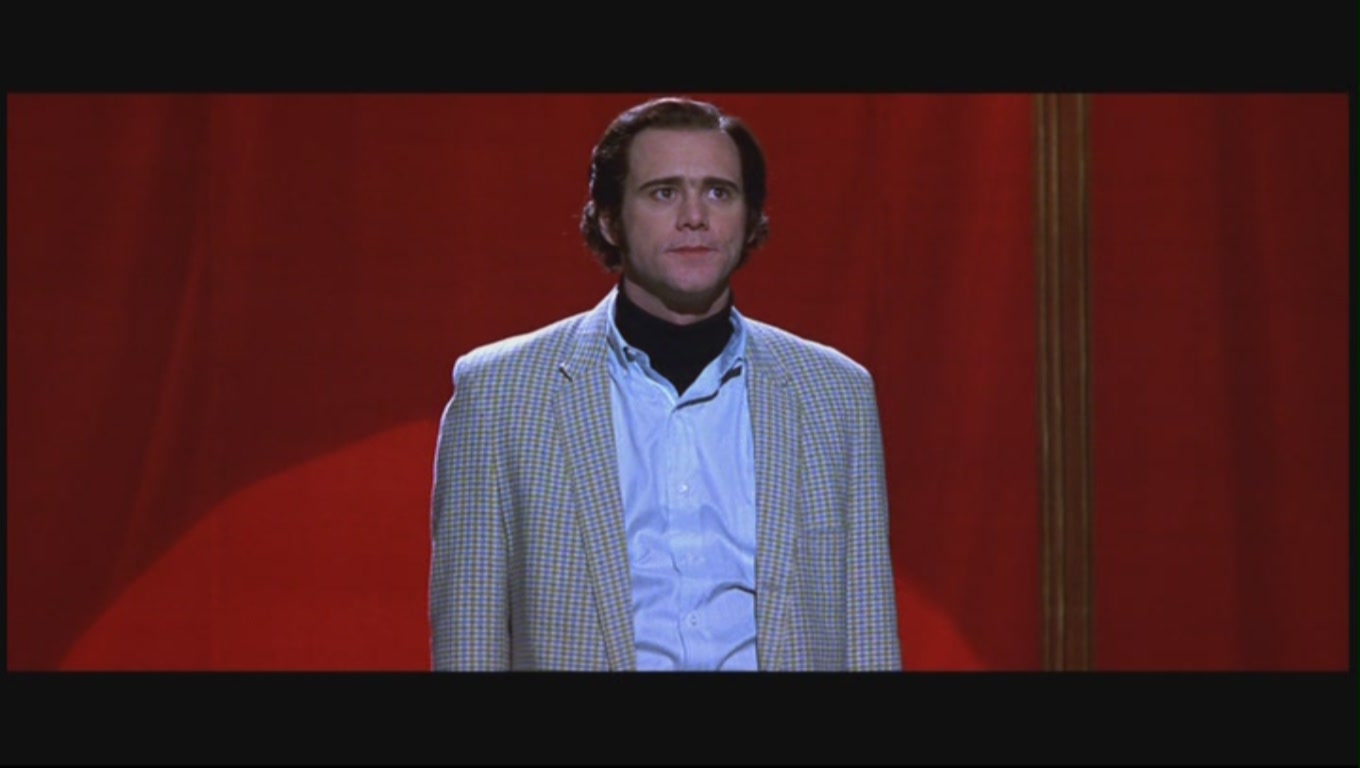
"You don't know the real me."
9. A DIRECTOR YOU ADMIRE BUT WOULDN'T WANT TO BE TRAPPED IN A ROOM WITH?
This is so random, I know, but Lars von Trier.
Ss-sca-sca-sca-scary!


10. FAVORITE MOVIE SO FAR THIS YEAR?
Instead of going with some obvious picks (Gravity, This is the End), I think I'll go with a few that aren't as recognized, but deserve to be seen: Trance, Only God Forgives, Fruitvale Station, I'm So Excited!, The Spectacular Now and Stoker. I know, I'm terrible at picking one. But this is my blog, after all. I do what I want!

 I will only nominate four, to uphold my lack of conformity (and because everyone's moved to wordpress, apparently). Be honored, be very honored:
Angry Vader's Movie Blah...
The Reviewing Dead with Nate
A Film Junkie
Vits-ing the Movies


Sunday, November 17, 2013

12 Years a Slave

In this stark and boldly oppressive tale, the only thing perhaps more harrowing than the protagonist's journey to survive false enslavement and torture is director Steve McQueen's brazen way of depicting it in the most honest and, quite often, deeply uncomfortable, yet cinematically applaudable manner.

12 Years a Slave is based on the memoir of the same title by Solomon Northup - an African American, living in New York, who was born free, kidnapped, sold into slavery, and kept in bondage for 12 years in the antebellum South.

In the film, Solomon (Chiwetel Ejiofor), a talented violinist, is hoaxed by two men claiming to be searching for musicians, who escort him to dinner and take advantage of him in his inebriated state. Solomon wakes up chained to a wall and told that he is no longer a free man. The rest of the film follows his journey working under the ownership of different slave-holders for the next 12 years of his life.

Solomon's survival is fueled by his desire to reunite with his wife and two children in New York but is tested by his own intelligence and often fool-hardiness. Solomon is an intelligent man, who has to hide his literacy from each master. At times, his intelligence gets the best of him and challenges a vapid-minded white man for faulty instructions -- this scene is cheer-inducing in the short run, but breath-holding-ly painful in the long run.

McQueen (Shame, Hunger) is not shy with his depictions of slavery; Beatings, whippings, rapes, hangings and other tortures are shown explicitly and unapologetically. Like Shame and Hunger, McQueen employs the long-take to capture such heinous acts in the most realistic and uncomfortable manner. There's nothing docile or, in the opposite extreme, overtly-gratuitous for the sake of it in these scenes -- they just...are.

McQueen's camera is often poetic, even ironic, capturing the enticingly open Louisiana sky. In one scene, Ejiofor breaks the fourth wall, by looking at the camera in a slow sweeping gaze - Ejiofor's haunting and pleading eyes gaze at us for a few seconds, before looking off camera again. This is similar to a scene in McQueen's Shame, where his sex-addict protagonist stares at the camera during an unemotional three-some. It's heartbreaking.

The film lacks on exposition and characterization in the beginning. We only see a few scenes of Solomon with his family, before he is surreptitiously whisked away. That's expected, though, with a film encompassing a long narrative time frame. Solomon's sorrow and bereavement, however, are not lost on us, which is the crucial part.

What is astounding, however, are the gritty performances. Ejiofor has a solemn and serious disposition, disrupted by weighty outbursts. He is completely vulnerable - physically and emotionally. By the end of the film, he appears as a man who's been through Hell and back, but maybe that's his settlement. "I don't want to survive," he states. "I want to live."

Paul Dano plays Tibeats, a hot-headed slave driver who has it out for Solomon and sings a deplorably nasty song (that I hope doesn't catch on). Tibeats' volatile and creepy persona draw comparisons to Dano's performance in There Will Be Blood, where he played a God zealot with greedy intentions. Here, Dano's portrayal of such an abominable character is superb. Somehow, we've come to love to hate him.

Among the many wonderful performances, none come close to Michael Fassbender's portrayal of Edwin Epps, a cotton plantation owner and a drunk who takes joy in waking his slaves in the middle of the night and making them dance, tiredly, in his lavish Southern home. Fassbender's magnetic off-screen charm is completely lost here. Epps is a deranged man with little self control and his uneasy physical proxemics to his slaves make him all the more creepy.

Unfortunately the soundtrack is not as memorable. Hans Zimmer's score is, in the moment, potent but tragically forgettable thereafter. At best, it appropriately ornates the story without overpowering it. Sometimes the most powerful scenes are ones accompanied by deafening silence, because they're usually a cacophony of emotions.

At its worst, the film is long and depressing. At its best, it's emotional and unnerving. There's little sense of resolution or cause for joy at the end. There's nothing uplifting about this film but that's the point, isn't it? The melancholic ending demonstrates that there is little to erase the tragedies that have occurred.

There's no forgetting this film either. Each scene is like sipping a cold pint of Southern-brewed sobriety. By the end, we're intoxicated with our country's shameful history.

Rating: A

Friday, July 26, 2013

Movie Review: Only God Forgives

Winding Refn Delivers another Art house-Style Crime/Drama


The film's opening scene establishes the viewer in a shady Bangkok underworld, effusing with drug smuggling, under-aged boxing matches, little to no dialogue - sans some Thai subtitles - and heavily under-lit shots. It's disorienting, rather than establishing. But director/writer Nicolas Winding Refn has already made a name for himself, cultivating independent films designed for a niche audience with an interest in aesthetic camera work that very often strays from mass market appeal.


Only God Forgives is no exception.

Winding Refn's last film Drive (2011) exemplifies the director's versatility, enveloping genres of a love-story and crime/drama in what many dubbed "art cinema." Or take, for example, his 2008 film Bronson, a violent tale of a convict in solitary confinement, with an alter ego who enjoys opera. While his films are arguably stylish, they have often been labeled as "style with no substance." However, it is not to say the former does not produce the latter. Though Winding Refn is often accused of focusing on aesthetics for lack of thought-provoking substance, his films speak visual volumes.

Only God Forgives is visually arousing. It pulsates with saturated colors - reds, yellows, greens - that bleed from the walls and room decor; the shadows are so dark and infinite, they lend an oddly nightmarish serene-like vibe as the film's protagonist walks past them in long tracking shots; and the sculptured masculine motifs help us illustratively arrive at the film's plot-line.

Julian (Ryan Gosling) and brother Billy (Tom Burke) are drug smugglers, running a drug ring in Bangkok, Thailand. When Billy is killed for the rape and murder of a 15-year-old girl, Julian and his crew pursue the men responsible to avenge Billy's death. Julian's mother (Kristin Scott Thomas), a degenerate person in her own right, flies in from the states to watch her son take revenge for the murder of her first-born.

The film is a silent spectacle of meticulously staged sets, an easily unobserved supernatural and religious element, a stoic protagonist who eerily glides out of the shadows without word or, more apparently, context, and, we the audience, are forced to surrender a part of understanding or even identifying a narrative structure for being desensitized spectators watching sadist acts and having great patience in watching them slowly play out. But it's usually worth it.

Winding Refn has crafted a true villain with Chang (Vithaya Pansringarm), the corrupt cop who ordered Billy's murder. Winding Refn creates a Bangkok-noir type of climate, where officials like Chang have as deep a blood lust as the criminals they torpedo after (His motto should be "to protect and sever"). The director makes a point to juxtapose Chang's violent exhibits with poignant karaoke sessions. Chang's stage spotlights him like a suspect lineup as suited officers watch with a restrained disposition. But, as the title of the film implies, he's ultimately in control.


To convey Julian's character, Winding Refn indiscreetly plants macho paraphernalia everywhere - the workout stations, the murder tools, the fist-clenching and well endowed statues - that serve to remind Julian, and us, of his masculinity and tests his mental and physical limit to uphold it. His lack of facial expressions and the film's lack of close-up shots create an emotional distance that is perhaps necessary for such a film that lacks a true sense of the word "hero." Julian doesn't truly seek revenge; he seeks forgiveness for his past.

Winding Refn, focuses on extended arms and hands throughout the film - a symbolic reminder of sin - i.e.: fighting poses, clenched fists, mundane acts like hand washing, or just awkwardly outstretched as if searching for meaning. This representation may reflect religious struggles Gosling's character faces in understanding his environment. He is consumed by his peccadilloes.

The film, as mentioned, is mostly silent. To attempt to answer the underlying question of "style over substance" might be rudimentary at this point, but necessary. Winding Refn's images narrate themselves. The film's gritty and dapper mise-en-scene create it's own text. The film's story-telling lies in the dexterous hands of cinematographer Larry Smith, production designer Beth Mickle and the rest of the art and costume crew. The film's tale of revenge, masculinity and Freudian motivations reads clearer off the decor than the subtitles.

To some this might come across as an unfinished film (such as the guy sighing throughout the whole move which made me want to pull a Chang on him), but to a pair of diligent eyes, it comes across as something to examine. It's work, but the studying pays off if one wants to try to understand the plot.

This is not to say the film reserves its nugget of knowledge for an elite few. Only God Forgives is far from cinematic gold and may come across as presumptuous at times. Does Winding Refn fail to introduce Gosling's character and develop his arc or does he bravely entrust in us the challenge of figuring it out ourselves?

Winding Refn is no pioneer in the screenwriting department, but at least his films are always entertaining, if not, at least, pictorially rewarding. Only God Forgives won't be rewarding for everyone, but to say a lack of substance is the main flaw of the film, might mean a second watch is necessary.

Rating: B+